
What Insulation Is Already in Your Attic, and Whether It Still Works
Before anyone can tell you whether your attic needs work, somebody has to establish what is up there already. Most of that can be done from the hatch with a flashlight and a tape measure, and knowing it changes what the right next step is.
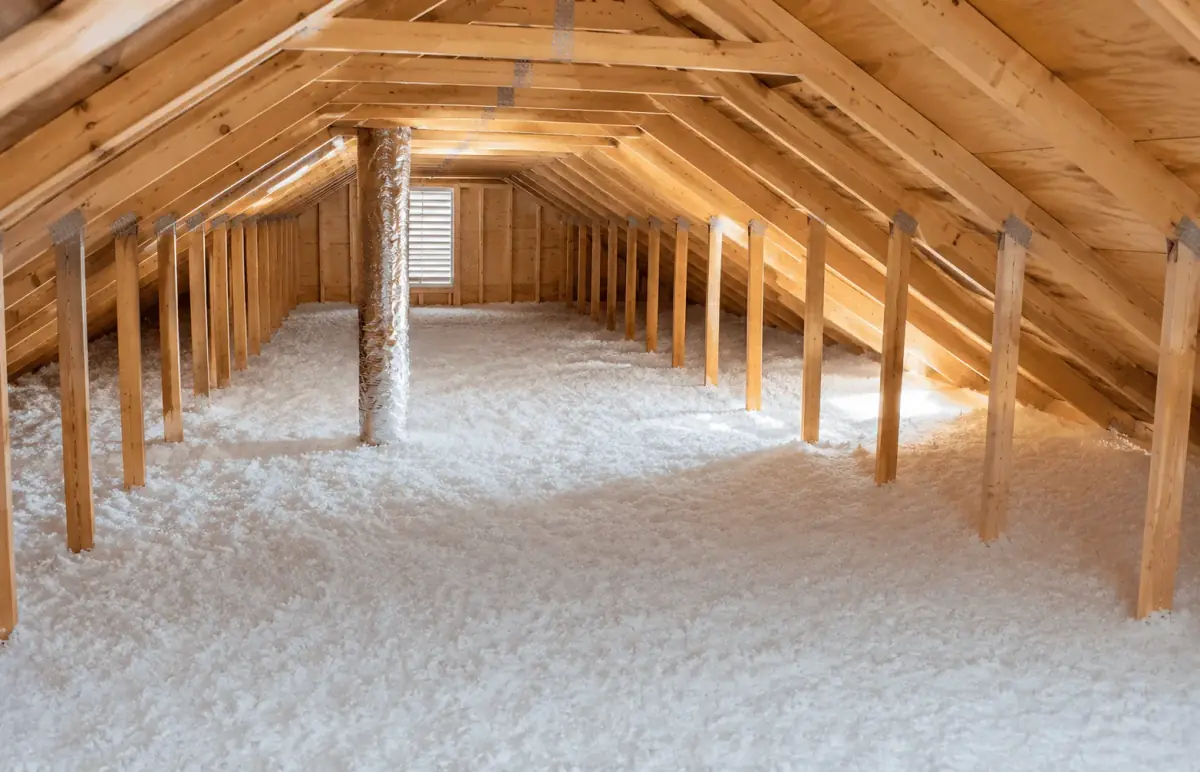
Color, texture and depth are enough to identify all six materials covered here. Five of them you can then do something about, and the sixth is the one to leave alone.
Quick answer: color, texture and depth identify nearly everything you will find in a Florida attic. Grey shredded paper is cellulose. Pink or yellow fluff is fiberglass. Rigid foam on the underside of the roof is spray foam. Small grey brown pebbles are vermiculite, and the Environmental Protection Agency's advice on that one is to assume it contains asbestos and leave it alone.
Start at the hatch, not in the attic
Almost everything you need is visible from the opening. Depth, color and whether the material is loose or in batts can all be read from there, and a phone photo with the flash on will show you more detail than your eyes do in that light.
In most attics the ceiling below is drywall held up by framing, and the insulation hides where the framing is. Stepping off a joist puts a foot through a ceiling, and in an older house there is a material up there you should not stir up at all.
Telling the materials apart
Loose-fill cellulose
Grey, sometimes a greyish brown, and visibly made of shredded paper. Up close you can often read fragments of print on it. It lies as a continuous blanket with no seams, packs in tighter than fiberglass, and feels dense rather than springy if you press it.
Cellulose is grey because it is recycled paper fiber rather than spun glass.
Loose-fill fiberglass
Pink, yellow or white, and obviously fibrous rather than papery. It sits looser and fluffier than cellulose and springs back a little when pressed.
Fiberglass batts
The same pink or yellow material, but in long rectangular blankets laid between the joists, sometimes with paper or foil facing on one side. Batts have visible seams and ends, which loose-fill never does. Gaps at the edges and around obstructions are the usual finding, and in a Florida attic those gaps matter more than the rated value printed on the packaging.
Rock wool and mineral wool
Denser and heavier than either of the above, usually a dull grey or brownish grey, and more granular in texture.
Spray foam
A rigid or rubbery layer sprayed directly onto a surface, usually the underside of the roof deck rather than the attic floor, and it holds whatever shape it was sprayed into. If the foam is on the roofline, the attic was deliberately brought inside the house, which changes what the space is for.
Vermiculite, the one to leave alone
Small, loose, pebble like granules, greyish brown or gold, roughly the size of coarse gravel and sometimes slightly shiny. It pours rather than mats.
If that is what you see, stop. The Environmental Protection Agency's guidance is to assume vermiculite attic insulation contains asbestos and not to disturb it, because the risk comes from fibers in the air. It advises against removing it yourself, and says that where removal is needed it is work for a trained and accredited asbestos abatement contractor, independent of whoever assessed it. The EPA adds that ordinary dust masks do not stop asbestos fibers, and that testing is often impractical for a homeowner, which is why assuming and leaving it is the advice.
That is not our work and we will tell you so. Insulation removal and replacement is, and vermiculite abatement is a separate trade with its own accreditation.
Depth is the second question
Once you know the material, a tape measure answers most of the rest. Push a rule straight down to the top of the ceiling framing and read the depth, in a few places rather than one, because loose-fill is rarely level.
ENERGY STAR's retrofit table, built on the 2021 International Energy Conservation Code, puts an uninsulated attic in this climate at R-49 and an attic that already has three or four inches at R-38. An R-38 to R-49 target is the common one for Northwest Florida attics, and that is what our crews blow to.
Translating depth into a rated value depends on the material, which is why identifying it came first. Settled loose-fill cellulose runs roughly R-3.2 to R-3.8 per inch, so an R-38 target lands somewhere near ten to twelve inches.
Settling, and what it actually means
Settling is normal and it is not damage. Loose-fill compresses under its own weight after installation, and the rated value is what it holds after that, not on the day it went in.
How much depends on the material. A Department of Energy document records loose-fill cellulose settling about twenty percent, against roughly two to four percent for rock wool and fiberglass loose-fill. Those figures are for attic installations.
So a cellulose attic that measures shallower than it did five years ago has not failed. The question is whether it settled to a depth that still holds the target, which is why a crew blows to a marked depth rather than to a bag count. If you have measured and come up short of the range above, that is a real finding and worth acting on.
Signs it has stopped doing its job
- Measured depth well under the range above, in more than one spot.
- Rooms that will not hold temperature while neighboring rooms do.
- Material that is dark or matted in patches, which usually marks air moving through rather than dirt falling on it.
- Visible gaps along the edges, around the hatch, or at the top of interior walls.
- A smell, or staining, which points at water rather than at insulation.
- Droppings, nesting material or tunneling through the blanket.
The last two change the answer from adding to removing, because material that is wet or fouled does not recover under a fresh layer.
When it can stay and when it comes out
Dry, clean loose-fill that is simply shallow can usually stay where it is and have more blown over it, which is the cheaper outcome and the common one. Our insulation replacement page covers that case.
Material that is wet, moldy, rodent fouled or compressed flat is a removal job first, and insulation removal covers what that involves. The one case that is neither is vermiculite, which goes to an accredited abatement contractor instead.
If you have measured and you are not sure which of those you have, that is a normal place to stop and ask. Once we get started, you get one number for the whole project. A free estimate puts someone in the attic who looks at it for a living.
Identifying Attic Insulation FAQs
What color is cellulose insulation?
Grey, or a greyish brown, and visibly made of shredded paper rather than fibers. You can often make out fragments of print in it up close. Fiberglass by contrast is pink, yellow or white and looks spun. If a cellulose attic has darker patches, that is normally dust tracking where air has been moving through the blanket rather than a second material.
How do I know if my attic insulation has settled?
Measure the depth in several places and compare it against the target for this climate, not against your memory of the installation. Some loss of depth is expected rather than a fault. What matters is whether the settled depth still holds the rated value you need.
Is the dust from attic insulation harmful?
The dust most people notice around a hatch or a ceiling fixture is usually fine paper or glass fiber carried by air moving through gaps, and the fix is sealing the openings it travels through. The exception is vermiculite, where the Environmental Protection Agency advises assuming asbestos is present and not disturbing it.
Can new insulation go on top of old insulation?
Often yes, when the existing material is dry, clean and simply shallow. It stops being an option when the material is wet, moldy, fouled by animals or compressed flat, and in those cases removal comes first.
How many inches of insulation should a Florida attic have?
ENERGY STAR's retrofit table, based on the 2021 International Energy Conservation Code, lists R-49 for an uninsulated attic in this climate and R-38 where three or four inches are already in place. Converting that to inches depends on which material you have.
Not Sure Which Way to Go?
That's a reasonable place to land, and it's the question we answer for free. Send the form or call, and we'll come look at the framing and the attic before recommending anything. No obligation.
- A straight answer on which material fits, including when it's the cheap one
- We install both materials, so we have no reason to push either
- Licensed, insured & BBB A+ accredited
- Family owned in Wewahitchka, working residential homes since 1994
Request Your Free Estimate
Give us the basics on your home and we'll get in touch.