
Cellulose Insulation Coverage, Settling, and R-Value
How cellulose coverage is figured, why loose-fill settles and dense-pack barely does, and why installing to a marked depth is what protects your R-value.
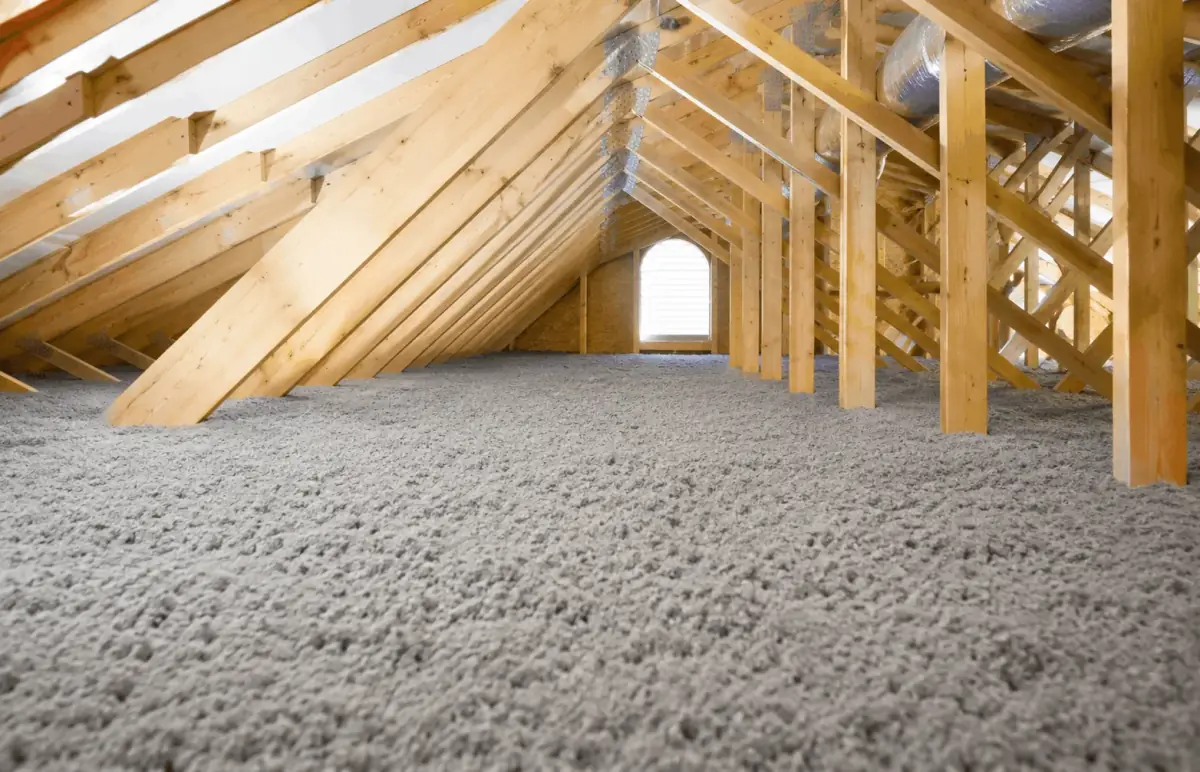
Blown-in cellulose insulation is a solid, well-proven attic material, but the numbers around it confuse a lot of homeowners. Coverage, settling, installed depth, settled depth: the terms sound interchangeable and are not. This page untangles them so you can read a coverage chart, understand why an installer blows more than the finished depth looks like it needs, and tell dense-pack from loose-fill.
Quick answer: Cellulose coverage comes from three numbers working together: the square footage, the installed depth, and the settled R-value you want. Loose-fill settles as the fibers compact, so a careful crew over-blows to a marked depth that still holds the target R-value later. Dense-pack, packed tight into walls, settles very little. What you are buying is the settled R-value, not the height on install day.
How Blown-In Cellulose Insulation Coverage Is Figured
Coverage is not a single bag-per-room rule. It is worked out from the area being covered, the depth the material is installed to, and the settled R-value the job is meant to reach. Every cellulose product carries a coverage chart printed on the bag, and that chart lists how many bags per hundred square feet are needed for a given R-value, along with both an installed thickness and a minimum settled thickness. Skip any of those numbers and the coverage is a guess. Get them right and the finished attic holds its rating.
Why Settling Happens, and Why Installers Plan for It
Answer first: loose-fill cellulose settles because freshly blown fibers sit fluffed up with air, then slowly compact under their own weight. A good crew expects this and blows extra depth on install day, setting depth markers across the attic so the material still measures at the target once it has settled. That is the reason the bag lists a taller installed thickness and a shorter settled thickness for the same R-value. The settled number is the one that counts. An attic blown only to the settled depth on day one will end up thin, and short of its rating, a few months later.
Dense-Pack vs Loose-Fill
These are two ways to install the same base material, for two different jobs.
| Application | Where It Goes | Settling |
|---|---|---|
| Loose-fill cellulose | Open attic floors, blown on top | Settles over time, so it is over-blown to a marked depth |
| Dense-pack cellulose | Walls and closed cavities, packed under pressure | Installed at high density, so it settles very little |
Dense-pack cellulose insulation is blown in at a much higher density than loose-fill, which is what lets it fill a closed wall cavity and stay put. Because it is packed tight, the dense-pack cellulose insulation R-value holds where a loose layer would compact, and that high-density cellulose insulation barely settles. Loose-fill is lighter and meant to lie in a fluffy blanket across an attic floor. Same fiber, different density, different behavior.
What Cellulose Is Made Of
Cellulose insulation is mostly recycled paper, ground into a fine fiber and treated with borate. The borate does two useful things: it gives the material fire resistance and helps deter insects and rodents. Because the fibers are small and dense, cellulose flows around wiring, framing, and awkward cavities well, which is why the same product works as loose-fill in an attic and as dense-pack in a wall. You can see how it fits our full lineup on the cellulose insulation and attic insulation pages.
Why Professional Installation to a Marked Depth Matters
All of this comes down to one thing: hitting the settled R-value takes the right amount of material spread to the right depth, verified with markers, using equipment that blows it in evenly. Guess the depth and you either overspend or fall short of the rating. Skip the settling allowance and the attic thins out later. This is not a material to eyeball. Installed correctly, cellulose is a strong, quiet, dependable choice for a Florida attic.
Want cellulose measured and installed to hold its rating? Request a free written estimate or call (850) 639-9272, Monday through Friday, 7:30 AM to 3:30 PM. We work with homeowners across Northwest Florida, South Alabama, and South Georgia.
Cellulose Insulation FAQs
How much does cellulose insulation settle?
Loose-fill cellulose blown into an open attic settles over time as the fibers compact, so a good installer blows extra depth on the day of the job to account for it. That is why the bag coverage chart lists both an installed thickness and a settled thickness for a given R-value. Dense-pack cellulose, packed into a wall or closed cavity at a much higher density, is already compressed and settles very little. The number that matters is the settled R-value, not how tall the pile looked on install day.
What is the R-value of cellulose insulation per inch?
Cellulose generally provides somewhere in the range of R-3.2 to R-3.8 per inch, similar to blown-in fiberglass, though the exact figure depends on the product and how densely it is installed. Coverage is worked out from three things together: the square footage being covered, the installed depth, and the settled R-value you are aiming for. Reaching an attic target like R-38 means installing to a marked depth that will still hold that R-value after the material settles.
What is cellulose insulation actually made of?
Cellulose is mostly recycled paper, ground into a fluffy fiber and treated with borate. The borate treatment gives it fire resistance and helps deter insects and rodents. It is a dense, well-established material that fills around wiring, framing, and odd cavities well, which is part of why it is used both as loose-fill in attics and as dense-pack in walls. As with any material, it performs when it is installed to the correct depth and density, which is a job for professional equipment.
How many inches of cellulose insulation do I need for R-30, R-38, R-49, or R-60?
As a rough guide, settled loose-fill cellulose runs about R-3.2 to R-3.8 per inch, so R-30 lands near 8 to 9.5 inches, R-38 near 10 to 12 inches, R-49 near 13 to 15.5 inches, and R-60 near 16 to 19 inches. Treat those as estimates, not exact numbers. The U.S. Department of Energy notes that the R-value of loose-fill does not rise in a straight line with thickness, because the material settles denser as it gets deeper, so the figure that counts is the settled R-value. The reliable source is the manufacturer's coverage chart, which lists the installed depth, the settled depth, and the bags per square foot for each R-value. In Northwest Florida attics, an R-38 to R-49 target is common, and our crew blows to a marked depth that still holds the target after settling.
Get a Real Number for Your Home
Everything above is background. The right depth and coverage for your attic comes from measuring it. Send the form or call, and we'll set a time to come look and put it in writing, with no obligation to go ahead.
- Material, R-value, depth, and square footage spelled out in writing
- Three decades of Northwest Florida attics, family owned since 1994
- Licensed, insured & BBB A+ accredited
- If the attic doesn't need work, we'll say so
Request Your Free Estimate
Tell us about the house and we'll reach out to schedule.