
Spray Foam vs. Fiberglass for Florida Homes
An even-handed look at where each material actually wins, where it loses, and why fiberglass is the right answer more often than the internet suggests.
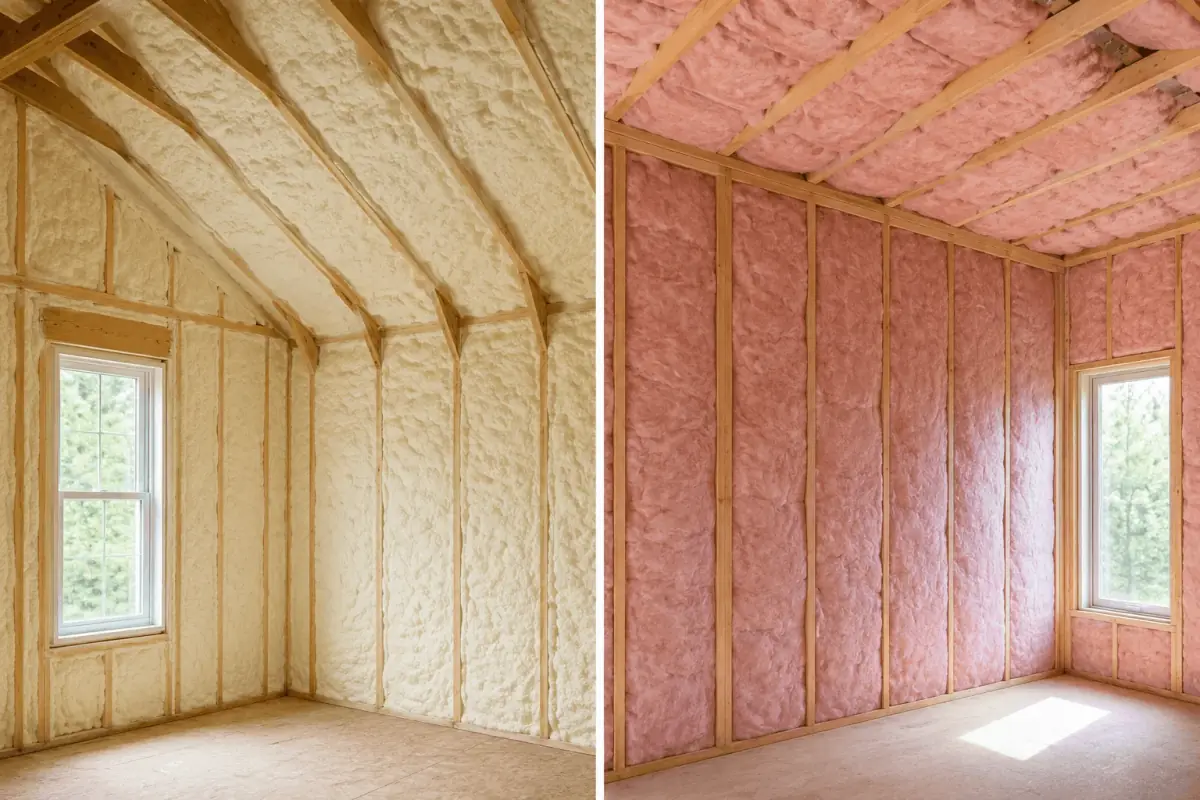
Spray foam gets talked about like an upgrade and fiberglass like a compromise. That framing is wrong, and it costs homeowners money. They're different tools. What matters is where you're insulating, whether the framing is open, and whether your real problem is heat, air leakage, or moisture. Here's the spray foam vs fiberglass comparison without a thumb on the scale.
Spray Foam vs Fiberglass, Line by Line
| Factor | Spray Foam | Fiberglass |
|---|---|---|
| R-value per inch | R-6.0 to R-7.0 (closed-cell) | R-3.0 to R-4.3 |
| Air sealing | Seals as it expands, no separate step | None on its own, needs sealing done first |
| Moisture control | Closed-cell resists it, and hides leaks above it | Must stay dry, but shows you when it hasn't |
| Upfront cost | Higher, by a wide margin | Lower |
| Working around obstructions | Conforms to odd cavities and pipe penetrations | Needs careful cutting and fitting, often rushed |
| Noise | Open-cell helps, closed-cell less so | Genuinely good at airborne sound |
| Where it's realistic | Open framing, attic decks, crawlspaces, rim joists | Open framing, plus blown-in for closed cavities |
Where Spray Foam Genuinely Wins
Spray foam insulation in Florida earns its price in three situations. When depth is limited, its R-6.0 to R-7.0 per inch does in two inches what fiberglass needs four or more to match, which matters at a cathedral ceiling or a shallow rim joist. When air leakage is the actual problem, it seals and insulates in one pass instead of two trades. And when moisture is relentless, as it is in a damp crawlspace or under a sealed attic deck, closed-cell holds up where fiberglass would be fighting the humidity forever.
Foam has real drawbacks too, and we'd rather you hear them from us: it costs considerably more, it's unforgiving of a sloppy installer, it's difficult to remove or modify later, and because it hides the sheathing behind it, a roof leak can go unnoticed longer than it would above open insulation.
Where Fiberglass Wins, Which Is Often
Here's the part most comparison pages skip: for a lot of Florida homes, fiberglass or blown-in is simply the better buy. A vented attic with plenty of headroom doesn't care that foam gets more R per inch, because depth is free up there. Blow it to R-38 or R-49, do the air sealing properly first, and you get the same thermal result for meaningfully less.
Fiberglass is also the honest choice for open framing on an addition, for floors, and for anywhere sound between rooms matters, where it outperforms closed-cell. It's forgiving, it's serviceable, and if a leak ever soaks it, you'll see the stain instead of finding rot years later. The catch is installation quality: gaps, compression, and batts stuffed around wiring wreck its performance in a way foam mostly shrugs off. Fiberglass done well beats foam done carelessly, every time.
One thing to understand before you tighten a house
Sealing a home up changes how it breathes, and that deserves a conversation before the work starts, not after. A house that used to leak air through a hundred small gaps was getting ventilation by accident. Take that away and you may need it on purpose, through mechanical ventilation, so humidity has somewhere to go.
It matters more if you have combustion appliances: a gas water heater, gas furnace, or fireplace that vents naturally relies on the house supplying it air, and a tighter envelope can interfere with how those units draft. This is manageable and routine, but it's a real consideration, and any contractor who waves it off is not thinking about your whole house.
So Which One Should You Use?
Most homes end up with both, and not as a compromise. Foam where depth is short or moisture is winning, blown-in or fiberglass across the open attic where it's the cheaper way to the same R-value. What decides it is your house, not a chart, and the spray foam vs fiberglass cost question usually sorts itself out once someone sees the space. Request a free estimate and we'll look at the attic, the framing, and where your air is actually going, then tell you plainly which material fits and which one you'd be overpaying for.
Spray Foam vs. Fiberglass FAQs
Is spray foam or fiberglass better for a Florida home?
Neither, as a blanket answer. Foam is the better tool where depth is limited, where air leakage is the core problem, or where moisture is constant, so crawlspaces, rim joists, and sealed attic decks. Fiberglass and blown-in are the better buy in a vented attic with headroom to spare, since extra depth costs little and gets you to the same R-value for less. Plenty of homes use both, in different places, for different reasons.
Does spray foam handle humidity better than fiberglass?
Yes, with one caveat worth knowing. Closed-cell foam works as insulation and a moisture barrier at once, which is why it holds up in damp crawlspaces where fiberglass would stay a problem. Fiberglass doesn't stop air or moisture on its own, so it depends on separate air sealing and on the space staying dry. The caveat: foam adhered to a roof deck also conceals that deck. A slow leak can soak framing for a long time before anything shows up on your ceiling, whereas water in fiberglass announces itself.
Can I foam or re-insulate walls that are already finished?
This is where the choice narrows a lot. Both materials assume open framing. Batts can't be fitted behind finished drywall, and spraying foam into a closed cavity means opening the wall or drilling and injecting, which is slow and hard to verify. For closed walls, blown-in through small access holes is usually the practical route. Foam makes the most sense during a remodel, an addition, or new work, when the studs are exposed anyway. If your walls are staying closed, put the money in the attic instead, since that's where the heat is coming from regardless.
Not Sure Which Way to Go?
That's a reasonable place to land, and it's the question we answer for free. Send the form or call, and we'll come look at the framing and the attic before recommending anything. No obligation.
- A straight answer on which material fits, including when it's the cheap one
- We install both materials, so we have no reason to push either
- Licensed, insured & BBB A+ accredited
- Family owned in Wewahitchka, working residential homes since 1994
Request Your Free Estimate
Give us the basics on your home and we'll get in touch.