
Air Sealing an Attic, and Why It Comes First
Insulation slows heat moving through a surface. It does very little about air moving through a hole. In a Florida house those holes are usually the reason an attic upgrade underdelivers.
Most attic upgrades in this part of Florida are sold on depth. Add inches, raise the R-value, done. Depth matters, but it is only half of the picture, and it is the half that gets measured because it is the half you can see with a tape.
Quick answer: Air sealing closes the gaps where conditioned air escapes into the attic and hot, humid air comes back down. It is done at the attic floor, before insulation goes over it, because most of the leak points become unreachable afterwards. Sealing and insulating together is what the savings estimates are actually based on.
What air sealing is, and what it is not
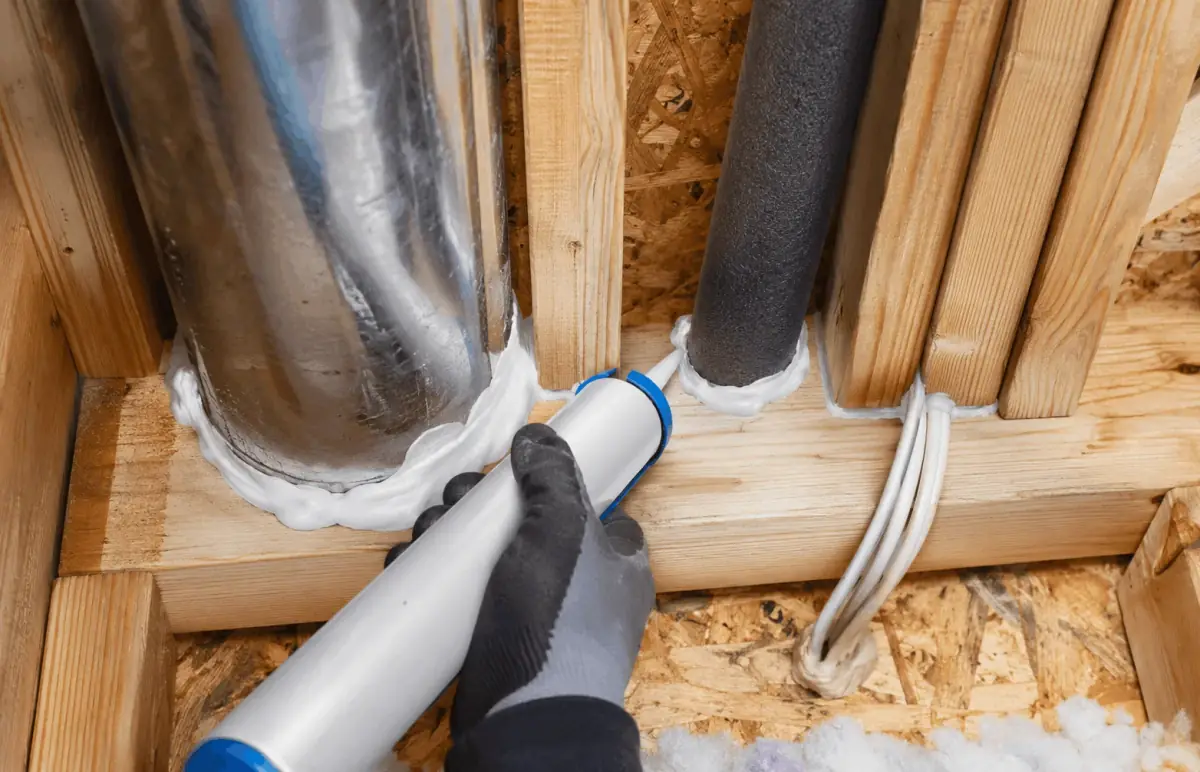
Air sealing means closing the physical openings between the conditioned part of the house and the attic. Caulk, foam, sealant, and rigid material over the larger gaps. It is not insulation, it is not weatherstripping the front door, and it is not the same as sealing ductwork, although the two often get done on the same visit.
The distinction matters because the two problems behave differently. Insulation resists heat moving through a solid surface. It does almost nothing about air moving through an opening, because air travels around it rather than through it. A gap the width of a pencil around a wire is not a heat transfer problem, it is a hole, and no amount of fiberglass over the top turns it into anything else.
Why it has to come first
These paths have a name in the trade, attic bypasses, and almost every worthwhile one sits at the attic floor: the top of the wall framing, the penetrations through the ceiling, the chases that run between floors. Once loose-fill has been blown across that floor, those points are under several inches of material. Finding them means moving insulation, which means disturbing what you just paid for.
This is the single practical reason air sealing belongs at the start. It is the one moment in the life of the house when those surfaces are visible and reachable at no extra cost. It is also why sealing is so often skipped, because skipping it is invisible to the homeowner and saves the installer an hour.
If an attic is being emptied anyway, the timing is even better. Our note on when attic insulation actually needs removing covers the situations where the floor ends up exposed for other reasons.
Where the leaks actually are
Top plates
The top plate is the horizontal timber at the top of a wall. Where an interior wall meets the ceiling, there is frequently a gap along that plate, and it runs the length of the wall. Multiply that by every interior wall in the house and it is usually the largest single leak area in the building. It is also completely invisible from below and buried from above.
Recessed lights
Older recessed cans vent air into the attic. Some are rated to be covered by insulation and some are emphatically not, and putting loose-fill over the wrong type creates a heat problem rather than solving an energy one. Fixtures like this normally need an airtight cover or replacement rather than sealant alone.
Plumbing, wiring and flue penetrations
Every pipe, cable and vent that passes through the ceiling was drilled oversize, because that is how you get a pipe through a hole. The gap around it stays. Individually they are small, and collectively they are not. Flues and anything that gets hot need a rated material and clearance, not canned foam.
The attic hatch
A plain plywood panel resting in a frame is a hole in the ceiling with a lid on it. It is one of the easiest things to improve, with weatherstripping around the frame and a rigid insulated cover on the panel, and one of the most commonly ignored.
Dropped soffits and duct chases
Where a ceiling has been dropped over cabinets, or a chase runs up through the house for ductwork, the top of that void is often open to the attic. These are large openings, and they connect directly into the interior of the house.
What the savings actually look like
Numbers get thrown around freely in this trade, so it is worth being precise about what the published figure is and what it covers. ENERGY STAR estimates that homeowners can save an average of 15% on heating and cooling costs, or 11% on total energy costs, by air sealing and adding insulation in attics, floors over crawl spaces, and accessible basement rim joists.
Three things about that figure deserve stating rather than glossing over. It is an average across typical existing homes, not a promise for any particular house. It is the result of sealing and insulating together, not sealing alone. And it includes basement rim joists, which almost no home in Northwest Florida has, so the applicable scope here is narrower than the sentence implies.
What it does establish is the direction and rough size of the effect, and that the two jobs are treated as one measure rather than as alternatives. That matches what we see. A house with new depth and open top plates does not perform like a house with both handled.
The humidity side, which matters more here
In a hot, humid climate the energy number understates the point. Air leaking into a house in July is not just warm, it is carrying moisture, and moisture is what makes an indoor space feel unpleasant at a temperature that should be comfortable. It is also what a cooling system has to work through before it makes any headway on temperature.
Reducing the flow of humid air into the house is one of the few things a homeowner can do that improves comfort and reduces the moisture load at the same time. The EPA is direct in its guidance on mold and health that controlling moisture is the way to control mold, since mold needs moisture to grow. Air sealing is one of the levers on that, alongside drainage, ventilation and fixing actual leaks.
It is worth being careful not to overstate this. Sealing is not a dehumidifier and will not fix a house with a genuine water problem.
What air sealing does not fix
It does not add R-value. A sealed attic with three inches of settled insulation is still an under-insulated attic, which is why the two are done together rather than one instead of the other. It does not fix leaking ductwork, which is a separate and often larger problem in homes where the ducts run through the attic. It does not compensate for a roof leak, and it does not resolve a cooling system that is the wrong size for the house.
How the work goes
The sequence on a typical visit is straightforward. The attic gets inspected and the leak points identified, which is the part that actually requires experience. Large openings such as chases get covered with rigid material and sealed at the edges. Smaller penetrations get foam or sealant appropriate to what is passing through them. Heat-producing fixtures get treated to their own requirements. The hatch gets weatherstripped and insulated. Then, and only then, insulation goes down to the target depth.
If you want the detail on the second half of that, how much insulation a Florida attic needs covers the depth side, and blown-in versus batts covers what usually goes back down.
Worth asking for by name
Because air sealing is invisible once insulation covers it, it is worth raising specifically rather than assuming it is included. Ask whether the quote covers sealing at the attic floor, which openings are being addressed, and what happens to any recessed lights. A quote that is only a depth and a price is a quote for half of the job.
We handle air sealing as part of most attic insulation work rather than as an upsell, because doing the second without the first tends to disappoint people. If you would like someone to look at what your attic is actually doing, the estimate is free and in writing.
Attic Air Sealing FAQs
Can I air seal an attic myself?
Some of it, yes. The attic hatch and a few reachable penetrations are within reach of a careful homeowner with canned foam and caulk. The parts that matter most, the top plates buried under existing insulation and the chases behind soffit drops, are the parts that are hardest to reach and easiest to miss. Most of the value is in the places that are difficult to get to.
Will air sealing make my house too tight?
In a house of ordinary age this is rarely the practical risk. Older homes leak far more than any current standard would allow, and sealing the attic plane brings them closer to normal rather than past it. Where a home is already tight, or where combustion appliances draw air from inside the house, ventilation deserves a look as part of the same conversation.
Does air sealing help with humidity indoors?
It helps with the share of indoor humidity that arrives as unconditioned air leaking in, which in this climate is a meaningful share during summer. It does not dehumidify. If a house has a moisture source such as a leak, a drainage problem, or an oversized system that cools without running long enough to dry the air, sealing will not resolve that on its own.
How long does attic air sealing take?
For most single-family homes it is a few hours, and it is normally done as part of an insulation visit rather than as a separate trip. The exception is a house where the existing insulation has to be moved or removed to reach the attic floor, which turns it into a longer job.
Is air sealing worth doing if my insulation is already deep?
Often yes, and it is one of the more common things we find. Depth and air leakage are separate problems, and a deep attic with open top plates still loses conditioned air. Insulation depth is measured easily and gets attention. Leakage is invisible and does not.
Not Sure Which Way to Go?
That's a reasonable place to land, and it's the question we answer for free. Send the form or call, and we'll come look at the framing and the attic before recommending anything. No obligation.
- A straight answer on which material fits, including when it's the cheap one
- We install both materials, so we have no reason to push either
- Licensed, insured & BBB A+ accredited
- Family owned in Wewahitchka, working residential homes since 1994
Request Your Free Estimate
Give us the basics on your home and we'll get in touch.