
Loose-Fill Insulation: The Types, Where Each One Fits, and How to Choose
Loose-fill insulation is the material that gets blown into an attic through a hose instead of laid down in rolls. It comes in a few types, and they are not interchangeable for every job.
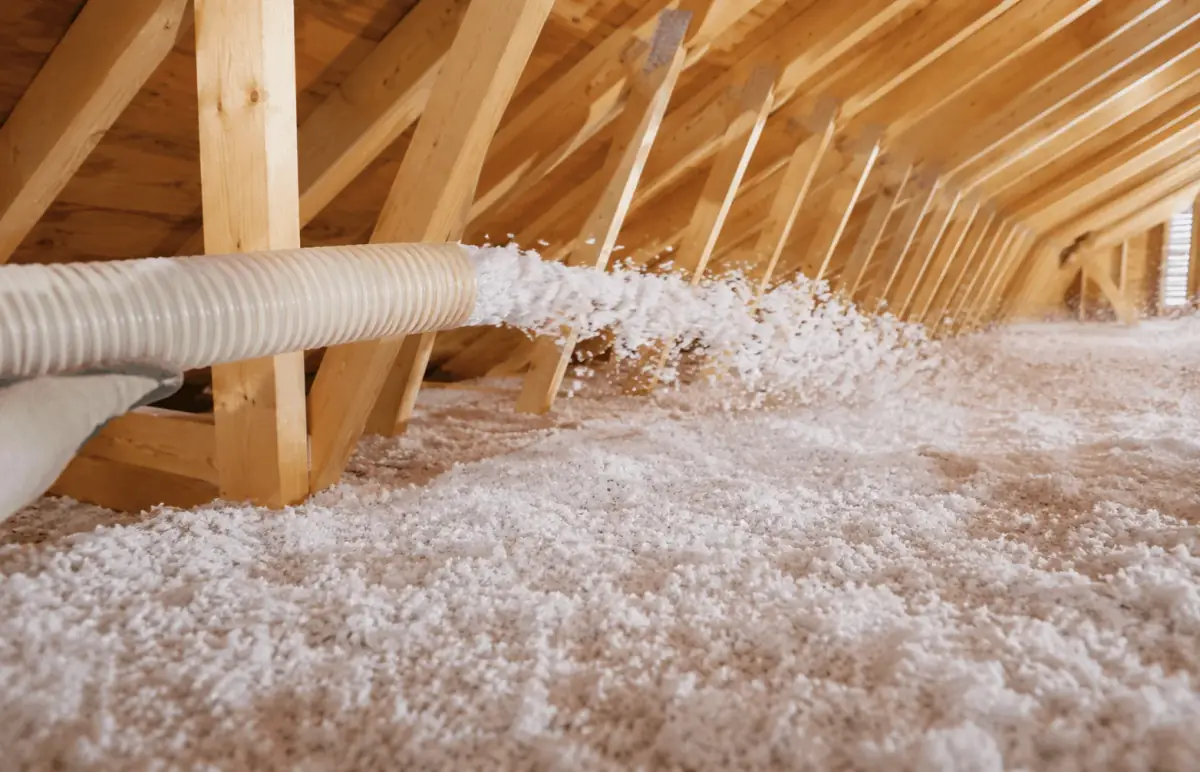
Loose fill is sold by the bag, and federal rules require each bag to carry a coverage chart for the R-value you are buying.
Quick answer: loose-fill insulation is small pieces of material blown into place by machine, so it fills around framing and wiring in one continuous layer. Fiberglass and cellulose are the two loose fills our crews blow. Mineral wool is also sold loose. Vermiculite is an older loose fill that the EPA says to leave undisturbed.
What loose-fill insulation is
Batts and rolls are cut to fit between the framing. Loose fill is broken into small pieces and blown through a hose, so it lands around wires, over the tops of joists and into the corners a rectangular batt has to be trimmed around. ENERGY STAR's guide to adding attic insulation notes that loose fill is applied with a blowing machine.
There are no seams to line up and no edges to leave short, which is why it suits an attic floor. What it does not do is stop air. Loose fill slows heat; it does not seal a gap, so the holes in the ceiling below need closing first, as our guide to attic air sealing explains.
The loose-fill insulation types you will run into
| Type | What it is | Where it shows up | Worth knowing |
|---|---|---|---|
| Fiberglass | Fine glass fibers, blown loose | Attic floors | The lighter of the two attic materials |
| Cellulose | Recycled paper fiber treated with borate | Attic floors, and dense-packed into closed walls | Denser and packs tighter than loose fiberglass |
| Mineral wool | Mineral fiber, also called rock wool | Sold loose as well as in batts | Our crews blow fiberglass and cellulose |
| Vermiculite | An older loose fill found in some homes | Older attics | The EPA says to assume it may contain asbestos and not disturb it |
Weights and depths vary by product. The label on the bag is the reference for the product in your attic.
Fiberglass and cellulose both get a Florida attic to the depth it needs.
A note on old loose fill
If you have an older house and cannot tell what the loose material in the attic is, do not dig into it to find out. The EPA's guidance on vermiculite says to assume it may be contaminated with asbestos, not to disturb it, and to hire a professional asbestos contractor if you plan to remodel. That is a separate trade from insulation work. Our guide to identifying attic insulation covers what you can safely learn from the hatch.
Where loose fill works, and where it does not
| Space | Loose fill? | Why |
|---|---|---|
| Open attic floor | Yes | It covers around framing and wiring in one layer and can go to any depth |
| Closed walls in a finished house | Yes, as dense-pack | Filled under pressure through small holes between the studs, then patched |
| Open walls during a remodel | Batts | The cavities are exposed, so batts can be fitted directly |
Closed walls are a different job from an attic floor, and our guide to insulating existing walls covers how it is done. For open framing, the comparison in blown-in vs batt insulation is the better starting point.
What the bag has to tell you
Loose fill is sold by coverage, not by thickness, so the bag carries a chart. Under the Federal Trade Commission's R-value rule, a loose-fill label has to list, at R-values of 13, 19, 22, 30, 38 and 49:
| On the chart | What it means for your attic |
|---|---|
| Initial installed thickness | How deep the material goes in on the day |
| Minimum settled thickness | How deep it has to stay to keep that R-value |
| Maximum net coverage area | How much floor one bag can cover at that R-value |
| Bags per 1,000 square feet | The bag count for a given area |
| Minimum weight per square foot | How much material belongs on each square foot at that R-value |
The R-38 and R-49 rows are the ones that matter here. ENERGY STAR's table, based on the 2021 energy code, gives R-49 for an uninsulated attic in our climate zone and R-38 to add where 3 to 4 inches are already in place. For cellulose in particular, our guide to cellulose coverage and settling walks through each row of the chart.
How to choose between fiberglass and cellulose loose fill
Which one we suggest comes down to your attic, what is already in it, and what you want out of it. These are the points that separate the two.
| If this matters to you | Leans toward | Why |
|---|---|---|
| A lighter material on the attic floor | Fiberglass | Loose-fill fiberglass is the lighter of the two |
| Recycled content | Cellulose | It is recycled paper fiber, treated with borate |
| Matching what is already in the attic | Either | ENERGY STAR says the new layer does not have to match the old |
On that last point, ENERGY STAR's guide says loose fill can go on top of fiberglass batts or blankets, and the other way round, provided a batt laid over loose fill is unfaced, with no paper or foil backing.
Our cellulose insulation and fiberglass insulation pages cover each material in more detail.
What has to happen before loose fill goes down
- The gaps in the ceiling are sealed, so air is not carrying heat around the insulation.
- Attic baffles go in wherever loose fill could otherwise block a soffit vent.
- Material is kept back from recessed lights that are not rated for insulation contact. ENERGY STAR's sealing guide calls for at least 3 inches of clearance and a barrier around the fixture.
- Depth markers go up, so the far corners get the same depth as the area by the hatch.
- The fill is blown from the far end back toward the access, so nobody walks across finished insulation.
If what is already up there is dry, clean and pest-free, we blow the new material straight over it. If it is wet, matted flat or fouled, we will recommend clearing it out first, since new insulation laid over bad insulation does not perform and only hides the problem. Our insulation replacement page covers that job.
What our estimate states
For a loose-fill attic job, our written estimate names the material, the depth we are blowing to, and the price. If old insulation has to come out first, the removal is on the estimate too. Our blown-in insulation page covers how the work runs, and our crews work across the Florida Panhandle, South Alabama and South Georgia.
If you are not sure which loose fill suits your attic, we will measure what is there and tell you. Get a free written estimate or call (850) 639-9272.
Loose-Fill Insulation FAQs
What are the main types of loose-fill insulation?
Fiberglass and cellulose are the two loose fills our crews blow into attics. Mineral wool, also called rock wool, is sold loose as well. Vermiculite is an older loose fill found in some homes, and the EPA says to assume it may contain asbestos and leave it undisturbed.
Is loose fill the same as blown-in insulation?
In practice, yes. Loose fill is the material and blown-in is how it gets installed, through a hose from a blowing machine.
Can loose fill go over the batts already in my attic?
ENERGY STAR says the new insulation does not have to match the old: loose fill can go over batts, and batts can go over loose fill if they are unfaced. On our jobs, if the existing material is dry, clean and pest-free, we blow the new layer straight over it.
How deep does loose-fill insulation need to be?
It depends on the product, because each one reaches a given R-value at its own thickness. The chart on the bag lists the settled thickness for each R-value, and ENERGY STAR gives R-49 for an uninsulated attic in our climate zone.
Not Sure Which Way to Go?
That's a reasonable place to land, and it's the question we answer for free. Send the form or call, and we'll come look at the framing and the attic before recommending anything. No obligation.
- A straight answer on which material fits, including when it's the cheap one
- We install both materials, so we have no reason to push either
- Licensed, insured & BBB A+ accredited
- Family owned in Wewahitchka, working residential homes since 1994
Request Your Free Estimate
Give us the basics on your home and we'll get in touch.